

The Spike Volleyball Story Expert Spiking Guide (2026)
Most players in The Spike Volleyball Story can spike. Very few can spike when it actually matters against a real block, in a tight tournament rally, on a bad set. This The Spike Volleyball Story expert spiking guide closes that gap. Four pillars, five spike types, and the drills that build them. No filler, just what works.
What Expert Spiking Actually Means in The Spike Volleyball Story
Most guides treat spiking like a single skill tap at the right moment and hope for the best. Expert spiking is not one skill. It is four working together: timing, power, placement, and deception. Drop any of them, and the AI starts reading you within three rallies.
The shift from intermediate to expert is mostly mental. Intermediate players think, “I need to spike this ball.” Expert players think, “Where is the block? Where is the open court, and which spike type beats this setup?” That decision happens in the second between the set and the jump. basics from our beginner guide
The 4 Pillars of Expert Spiking
You will see these four pillars repeated throughout this guide because everything else builds on them:
- Timing — hitting at the peak of your jump, not before, not after
- Power — using the right amount for the situation, not maxing every swing
- Placement — picking the open zone, not the closest point
- Deception — varying your attack so the AI cannot predict you
A good intermediate has one or two of these. An expert has all four and switches between them rally by rally.
How Expert Spikers Think Differently
When intermediates lose a rally, they blame timing. When experts lose, they ask which of the four pillars failed. That diagnostic mindset is what lets them adjust mid-match instead of grinding the same mistake into a 0-3 set.
The Foundation Perfect Spike Timing
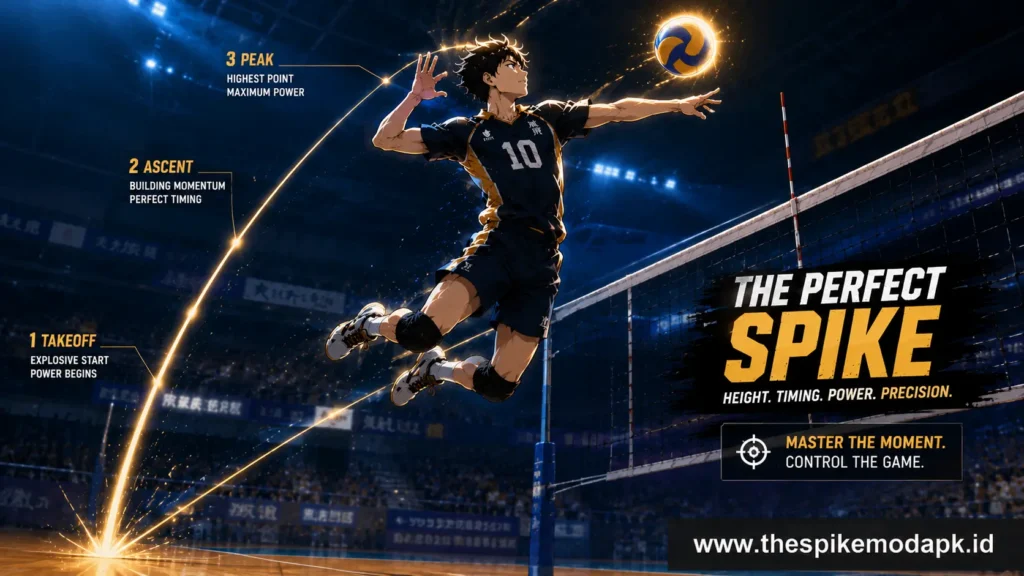
Everything starts here. If your timing is off, no stat upgrade in the world will fix the rest. The good news is that timing in The Spike Volleyball Story is predictable — once you understand what to watch for, you can hit it on demand.
Hitting the Ball at the Peak of Your Jump
The single most important rule: strike at the apex of your jump, not on the way up. Hitting on the rise gives you a flat, weak attack that is easy to block. Hitting on the descent kills your power. The peak gives you the sharpest downward angle and the most force behind the ball.
Watch your player’s silhouette, not the ball. The ball moves; your jump arc is consistent. Train your eye on when your player stops rising — that is your strike window, and it lasts maybe a third of a second.
Reading the Setter’s Timing
Spiking starts before you jump. As soon as the set leaves the setter’s hands, you should already be moving into your approach. Late approaches force you to jump from a stationary position, which kills both height and power.
In manual mode, watch the setter’s animation. The set has a fixed flight time — once you learn it, your approach becomes automatic and your jump times themselves. This is the moment most intermediate players skip, and it is why their spikes feel inconsistent.
Why Manual Mode Is Non-Negotiable
If you are still playing on Auto or The Spike Volleyball Story expert spiking guide , stop reading and go switch them off. Auto picks safe, predictable shots. The AI defense reads safe and predictable, especially in higher tournament tiers.
full game features and modes. Manual mode is harder for the first ten matches. After that, it becomes the only way you play, because no auto setting will ever let you hit the deception pillar — and without deception, you cap out fast.
Watch a quick visual demonstration of expert spike timing below:
Stat Upgrades Where Expert Spikers Spend First
Your spike is only as good as the player executing it. Two players with identical timing will produce wildly different results based on how their stats are built. Here is where to put your resources.
Spike Power vs Jump, What to Max First
The rookie mistake is dumping everything into Spike Power The Spike Volleyball Story expert spiking guide. Power matters, but a powerful spike that gets blocked is still a lost point. Jump should be your first priority because jump height directly affects your hitting angle — the higher you strike, the steeper the ball drops, the harder it is to dig.
Once your Jump is strong, then push Spike Power. Aim for a roughly 60/40 split favoring Jump until Jump is maxed for your tier, then flip to favoring Spike Power. This sequencing is what creates the steep, unreadable attacks that expert spikers are known for.
Speed and Reaction Stats
Speed determines how fast you reach the approach spot. Slow players arrive late, jump flat, and spike weak. Reaction affects how cleanly you can adjust to bad sets — and bad sets happen constantly.
Treat Speed and Reaction as support stats, not primaries. Top them up only after Jump and Spike Power are strong. Spreading points evenly across all four is the most common build mistake at the expert level.
Position-Specific Builds
A wing spiker, an opposite, and a middle blocker need different stat priorities even though they all spike:
- Wing spiker — balanced Jump + Spike Power, with Speed close behind, because they cover more court
- Opposite — heavy Spike Power, since the right-side attack is usually a higher, harder swing
- Middle blocker — Speed and Reaction first; their attacks are quick tempo and demand fast read-and-react
Build for the role, not the player name. A middle who is built like a wing spiker becomes useless because the quick-tempo attack collapses without speed.
Spike Types Every Expert Must Master
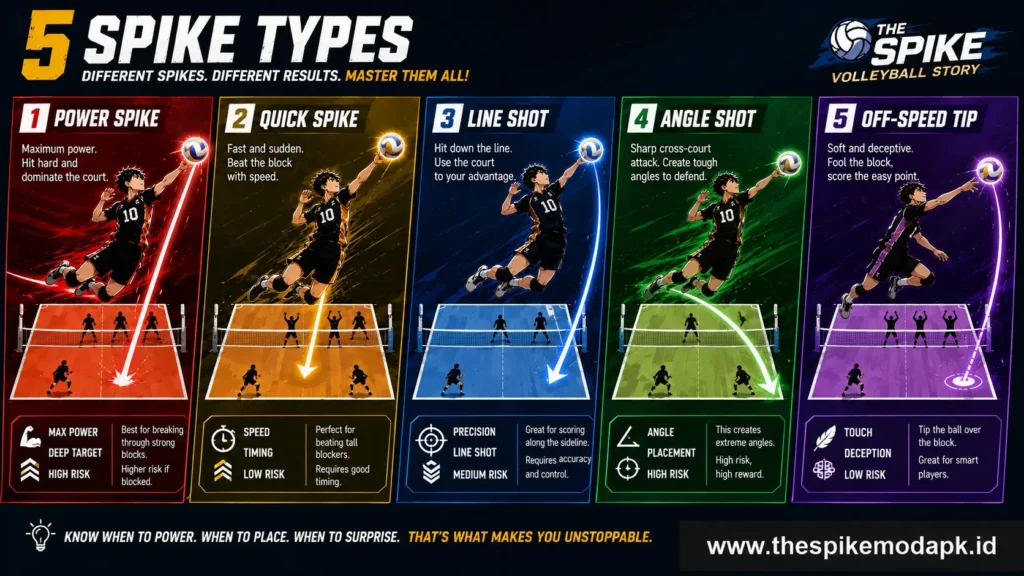
If you only have one spike, the AI learns it by rally three. Experts carry a full toolbox. These are the five types you need on demand.
Power Spike When It Wins Points
The power spike is the loudest tool in your kit and the most overused one. The Spike Volleyball Story expert spiking guide It works best when:
- The blocker is mistimed or out of position
- You have a clean, open lane to the back row
- You need to break a long rally with one decisive swing
It does not work when the block is set, ready, and reading you. Spamming power into a good block is how rallies turn into easy counterattacks for the opposing team.
Quick Spike Beating the Block
The quick spike is the answer to a strong block. It is a faster, lower-trajectory attack that releases before the blocker fully extends. You give up some power, but you remove the block from the equation entirely.
Use the quick spike when you are facing a tournament team that blocks well, or when your setter delivers a low, fast set. Pair it with a power spike on the next rally to keep the defense guessing.
Line Shot vs Angle Shot
Every spike has a direction, and most players default to whatever feels natural, usually the cross-court angle. Good defense positions for that, so always-angle players get shut down.
The line shot drives straight down the sideline. It is narrower but catches the defense leaning. The angle shot crosses the court diagonally. It opens more court, but it is the one defense they expect. Mix both at a rough 50/50 frequency until you spot which one a specific opponent struggles with.
Off-Speed Spike (The Dump or Tip)
When the block is fully set and the back row is deep, the smartest play is often not to spike hard at all. The off-speed spike a soft tip that clears the block and drops in the open zone — wins rallies that no power swing could.
This is the most underused tool in the game at the expert level. Three or four off-speed drops per match break the AI’s defensive rhythm completely.
The Fake Spike Move
The fake spike is the deception pillar in its purest form. You go up in full power form, then at the last instant, tap softly. The Spike Volleyball Story expert spiking guide. The blocker has already committed to a full block, the back row has shifted for power, and the ball drops into an empty court.
Use it sparingly — once it becomes a pattern, the AI adjusts. Once every six or seven attacks is a good rule. Used too often, it stops working and becomes a wasted set.
Reading and Beating the Block
Expert spiking is half attacking and half reading defense. Every rally, before you swing, your eyes should locate the block. Without this habit, you are just guessing.
Identifying the Blocker’s Position
Watch where the opposing blocker is set up the instant the ball leaves your setter’s hands. Are they centered? Shifted line? Shifted angle? Their position tells you which lane is open before you even jump.
If the blocker is centered, you have line and angle equally open — go with whichever you have used less recently. If they have shifted the line, hit angle. If they have a shifted angle, hit line. It sounds obvious; very few intermediate players actually do it.
Hitting the Tool (Off the Block’s Hands)
When the block is well-positioned, and the lanes look shut, experts hit into the block, not around it — but at an angle that ricochets the ball out of bounds off the blocker’s hands. This is called “using the tool.”
It requires hitting the outside edge of the block at a slight angle. Done right, it scores a clean point and resets the block’s confidence for the next rally.
When to Spike Past vs Tip Over
If the back row is deep and the block is set, tip over. If the back row is shallow and the block is flawed, spike past. Reading both at once is the highest-skill moment in any rally, and it is the moment that separates ranked players from casual ones.
Position-Specific Spiking Strategy
Different positions spike differently. Building one universal “spike strategy” is why a lot of expert players stall — they treat every attack as the same.
Wing Spiker (Outside Hitter) The Main Scorer
The wing spiker is your bread-and-butter attacker. Most sets come here, and the position rewards a versatile toolbox — line, angle, power, off-speed. Your job is consistency: hit your shots cleanly and do not gift the defense free points.
The biggest wing spiker mistake is going for highlight-reel kills every rally. Hit the open court, take the steady points, and save the big swings for moments when you have broken the block down.
Opposite The Right-Side Attacker
The opposite gets fewer sets but bigger ones. When the ball comes to you, it is usually a high-power set meant for a hard swing. Lean into Spike Power and the line shot opposite spikers who hit hard down the line are nearly impossible to stop.
Avoid trying to be a finesse player, as the opposite. The position is built for force, and finesse attacks rarely come with right-side sets.
Middle Blocker Quick Attacks at the Center
Middle attacks are all about speed and surprise. You are getting fast, low sets that have to be hit immediately. There is no time for a power approach, so do not try.
Your weapon is the quick spike at the center, often hit before the opposing block can fully form. Build Speed, build Reaction, and trust the tempo. A well-timed middle quick is one of the most efficient point-scoring patterns in the game.
Practice Drills That Build Expert Spiking
You do not build expert spiking in tournaments — you build it in training. These four drills do more than a hundred random matches:
Drill 1 — The 50-Spike Timing Lock-In. Enter Training Mode, switch to manual, and execute 50 consecutive spikes focused only on hitting at the peak of your jump. Ignore power, ignore placement. Pure timing. Stop after 50 even if it is clean — repetition is the point.
Drill 2 — Spike Type Rotation. In Training, force yourself to alternate spike types in a fixed pattern: power, quick, line, angle, off-speed. Repeat for 20 rotations. This builds the reflex to vary attacks under pressure.
Drill 3 — Block Reading Drill. Play story-mode matches where your only rule is to call out (in your head, or out loud) where the block is positioned before every jump. Do not worry about winning the match. Focus only on reading speed.
Drill 4 — One-Spike-Only Match. Play an entire match using only one spike type — for example, only quick spikes. You will lose. The point is to see where that single tool fails, so you understand exactly when to use it and when to switch.
Do these four drills for one week, and your tournament win rate visibly climbs. Skip them, and you will keep grinding the same mistakes into ranked play.
Common Mistakes That Hold Expert Spikers Back
A handful of repeated errors account for most stalled progress at the expert level:
- Maxing Spike Power before Jump — leaves you spiking low and getting blocked.
- Using only one or two spike types, the AI reads you within minutes.
- Ignoring the block before every jump — you spike blind and lose lanes you should own.
- Auto Mode in ranked play — caps your ceiling no matter how good your team is.
- Force-spiking against a strong block — when the lane is shut, tip; do not smash.
- Treating every position the same — a middle is not a wing, it is not the opposite.
Audit your last few matches against this list. Two or three of these will jump out, and fixing them moves you up a full tier faster than any roster change.
Frequently Asked Questions
How do you spike better in The Spike Volleyball Story?
You spike better by mastering four pillars together — timing the ball at the peak of your jump, building Jump stat before Spike Power, mixing power, quick, line, angle, and off-speed attacks, and reading the opposing block before every swing. Manual mode is required to develop these skills fully.
When should you use a power spike vs a quick spike?
Use a power spike when the block is mistimed, out of position, or the back row is shallow. Use a quick spike when the block is set and reading you, since the faster low-trajectory attack releases before the blocker fully extends. Mixing both keeps the AI defense from settling into a pattern.
What stats should expert spikers upgrade first?
Prioritize Jump first, since higher contact points create steeper, harder-to-dig spikes. Push Spike Power next, then top up Speed and Reaction. Avoid spreading points evenly — a player with no standout strength gets exposed at the expert level, especially in late tournament rounds.
How do you beat the block in The Spike Volleyball Story?
Beat the block by reading its position before every jump, then choosing the spike type that exploits it — angle if it is shifted line, line if it is shifted angle, quick if it is set well, and an off-speed tip if all lanes look shut. Hitting the tool off the blocker’s hands is another expert option.
Is manual mode necessary for expert-level spiking?
Yes. playing on iOS Auto and Beginner modes pick safe, predictable shots that the AI defense reads easily, and they prevent you from using deception techniques like the fake spike. Manual mode is the only way to reach expert-level spike timing, placement, and unpredictability. Switch it on permanently.
Conclusion
Expert spiking is not a single trick it is the four pillars working together: timing, power, placement, and deception. Build your stats with Jump first, master all five spike types, read the block before every jump, and treat each position as a distinct role. That is the system.
Run the four drills until they are automatic. Audit yourself against the common mistakes list weekly. And above all, switch to manual mode and stay there. Climbing tiers is not about playing more matches, it is about playing every rally with the four pillars in mind. Now load up The Spike Volleyball Story and put this expert spiking guide to work on your next ranked match.